Window 15
What Is That to You?
Comparisons keep us looking sideways. Shame keeps us looking backwards. But grace helps us look forward with joy.
I have a favorite scene in the Bible. I'm not sure you're supposed to have one. It feels a little like choosing your favorite child. But I do.
It's John 21.
And to understand why I love it so much, you have to understand that I resonate deeply with the Apostle Peter there.
See, Peter was always looking sideways. He was the loud one. The confident one. The disciple who seemed perpetually convinced that whatever the situation required, Peter was the man for the job.
And sometimes that meant comparing himself to everybody else.
When Jesus told the disciples they would all fall away, Peter essentially said:
Maybe these losers.
But not me.
Seriously.
"Even if all fall away, I will not."
That's an impressive amount of confidence in one sentence.
Peter wasn't simply saying, Jesus, I love you.
He was saying, Jesus, I love you more faithfully than these guys do.
I've done that. Maybe you have too.
We look sideways to figure out how we're doing. Am I more successful than him? Are my children doing better than theirs? Is my marriage stronger? Am I more faithful? More spiritual? More important?
Comparison can make you feel pretty good about yourself. Until it doesn't.
Because within hours of announcing that everybody else might fail Jesus but he never would, Peter denied even knowing Him.
Three times.
And then Jesus died.
And I can vividly imagine the shame Peter must have felt.
I know what it's like to replay something you wish you could undo. To remember what you said. Or didn't say. What you did. Or didn't do. To wonder whether your worst moment has revealed who you actually are.
I know that's why I've returned to this story so many times.
After the resurrection, Peter and some of the disciples go fishing. Early one morning, while they're out on the Sea of Galilee, someone appears on the shore.
It's Jesus.
Peter doesn't recognize Him at first, but John does.
"It's the Lord."
And that's all Peter needs to hear. He puts on his outer garment and throws himself into the water. Which I love, because it is such a Peter thing to do. And I think I would have done the same thing.
The other disciples apparently looked at the situation and thought:
Peter, buddy. We're in a boat. The boat is going to shore. We can take you.
But no. Peter is in the water.
Religious paintings make biblical people look so dignified, but I doubt this was dignified.
Have you ever tried to run through water?
It's terrible. You're splashing everywhere. Your clothes are sticking to you. You can't get your feet underneath you. I think there's a decent chance Peter stumbled at some point and went face-first into the Sea of Galilee.
But here's the thing: He didn't care. For once, he didn’t care what anyone else thought of him.
Jesus was on the shore. The resurrected Jesus.
I've thought about that moment for years, but perhaps not in the way you might expect. I've wondered what Jesus saw on Peter's face as Peter came toward Him.
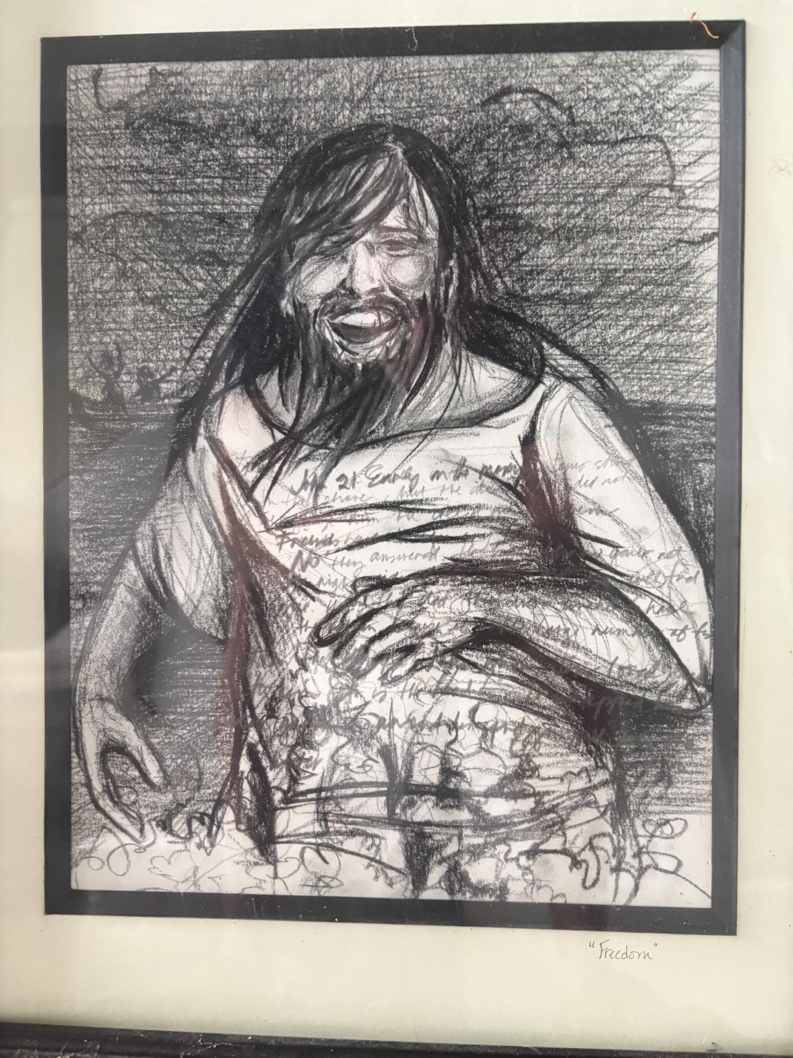
John doesn't tell us, but that question has captured my imagination for so long that years ago a painting of the scene was commissioned for my birthday.
It's Peter running through the water toward Jesus.
And Peter is smiling. Actually, smiling doesn't quite describe it.
He looks almost deliriously happy. He's wet and wild and completely undignified, his arms pumping, his mouth open, running toward the man he had denied three times.
The painting is called "Freedom” because shame usually makes us run the other direction. Shame hides. Shame covers itself. Shame says, Don't let him see you. But Peter throws himself into the water and he runs toward Jesus. And maybe that's what freedom looks like.
I like imagining that Jesus saw a man who, despite everything he had done, somehow knew where he needed to go. And I know what Peter found when he got there.
Breakfast.
Jesus wasn't standing on the beach with His arms folded. He didn't make Peter crawl the last twenty yards. He didn't say:
"Well, look who decided to show up."
He was making breakfast.
Fish, unfortunately. I confess that part of the story has never spoken to me quite as deeply. I had fish a couple of times in Israel that made me wish Jesus had chosen pancakes, and I've never walked into a Waffle House and ordered the catch of the day.
But regardless, breakfast was waiting.
And later, beside a charcoal fire—the same kind of fire beside which Peter had denied Him—Jesus asked him three times:
"Do you love me?"
Three denials.
Three opportunities to say yes.
And then Jesus gave Peter the invitation with which this whole adventure had begun years before:
"Follow me."
Years later, I went to Israel. One day our group visited the traditional site associated with this story along the Sea of Galilee. There was a church there. Tourists. Things to see. Things to photograph. But I wandered down toward the water.
I wanted the beach.
I stood there looking across the Sea of Galilee and did something I had done in my imagination many times before. I put myself in the water. I imagined running toward Jesus.
Awkwardly. Desperately. But joyfully.
Carrying all the things I wish I had done differently. All the things I wish I hadn't said. All the ways I've failed people. All the ways I've failed Him. All the shame.
But running toward Him.
That's the part of Peter's story I need.
Because shame tells me to hide.
Jesus says:
Come have breakfast.
He feeds Peter. He forgives him. He restores him. And then He says:
Follow me.
And that would be enough for me.
Except John 21 has one more little detail. And it may be my favorite part of the whole story.
After the swimming and the breakfast and the forgiveness and the restoration, Jesus tells Peter something about where following Him is eventually going to lead. It's not going to be easy. In fact, Peter's road is going to end painfully.
And Peter does something wonderfully, ridiculously human.
He looks sideways again.
He turns around. And there's John. And Peter asks Jesus:
"What about him?"
There he is. The old Peter.
Jesus has just dragged him out from underneath the crushing weight of his greatest failure. He's been restored for approximately twelve minutes. And he's already comparing himself to somebody else. Again.
Apparently resurrection does not immediately cure us of being idiots.
Jesus' answer is one of my favorite things He ever says. Basically:
What happens with John is none of your business.
"What is that to you? You follow me."
And suddenly the whole story comes together.
Before Peter's failure: What about them?
After Peter's restoration: What about him?
Peter keeps looking sideways. And Jesus keeps turning his face back toward Him.
I know that movement. I spend so much of my life looking sideways too.
What about him? Why did she get that? Why is their life going that way? Why did mine go this way? Why did they get more time? Why did I lose what I lost? Why does their story seem easier than mine? Why do they have that and I don't? What about them, Jesus?
And again and again, He turns my face back toward Him.
What is that to you? You follow me.
That's what I needed most on that beach in Galilee. Not archaeological certainty that I was standing on the exact patch of ground where Peter stood. Not some overwhelming spiritual experience. Just the picture I've carried with me for years.
Jesus on the shore. Me coming through the water.
Wet. Clumsy. Ashamed.
Probably falling on my face at least once.
But coming toward Him because comparison makes me look sideways. Shame makes me look backward. But grace lets me run toward Jesus.
And when I get there, Jesus isn't looking past me at John. He's looking at me. Breakfast is waiting. There is forgiveness for what is behind me. There is grace for what is in front of me.
And there is really only one thing I need to know about everybody else's road:
"What is that to you?"
Come on. We've got things to do.
You follow me.