Window 11
The Unmarked Grave
A walk through an Austin cemetery and lunch at Freedmen’s reveal the difference between making a name and making a difference.
I like walking through cemeteries, which I realize probably eliminates me from consideration as the life of the party.
But cemeteries are good places to think.
For years, I wrote sermons while walking, and occasionally my walks carried me through a cemetery. Walking among the dead has a way of shrinking the emergencies of the living.
In Austin, one of my favorite places was the Texas State Cemetery.
It is an impressive place. Texas being Texas, even death has a certain amount of swagger.
Governors are buried there. Senators. Generals. Judges. Texas Rangers. There is even a memorial to Tom Landry, the legendary coach of the Dallas Cowboys—complete, naturally, with his famous fedora.
The lawns are carefully groomed. Monuments rise from the earth. Names are carved deeply into stone so no one will forget that somebody important lies underneath.
That is partly what monuments are for.
To make sure a name outlives a life.
But one day, my walking took me from the Texas State Cemetery to nearby Oakwood Cemetery.
There I encountered a preacher named Jacob Fontaine.
Fontaine was born into slavery. By the 1850s, he was living in Austin, where he served as a sexton at St. David’s Episcopal Church and preached to Black worshipers in the afternoons.
By 1864, while still enslaved, he was helping Black members of First Baptist Church organize a congregation of their own. After emancipation, he founded First Colored Baptist Church and eventually five other churches in the Austin area.
He helped establish an association connecting Black Baptist congregations across Central Texas. He operated businesses, became active in civic life, and founded The Austin Gold Dollar, one of the earliest Black newspapers west of the Mississippi.
A preacher. A church planter. A publisher. A businessman. A community builder.
I was a church planter in Austin too.
I knew something about wanting to do meaningful work. And, if I am honest, I also knew something about wanting people to know that I had done it.
But suddenly, my little church plant did not seem quite so heroic.
Then I read the final sentence on Fontaine’s historical marker.
He was buried somewhere in that cemetery—
in an unmarked grave.
The marker bore his name, but the ground did not. There was no headstone beneath which I could confidently say, Here lies Jacob Fontaine.
I had just walked among monuments erected to keep important names from disappearing.
Fontaine’s actual resting place had disappeared.
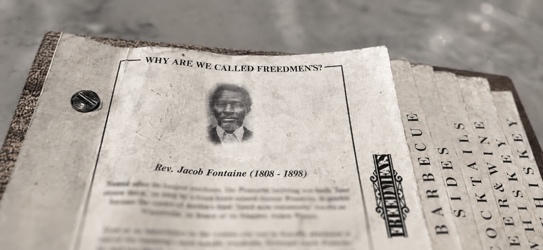
Later that day, I met a friend for lunch at a barbecue restaurant called Freedmen’s.
The barbecue was excellent.
I feel obligated to establish that because this was Texas, and one should not make careless claims about barbecue.
Freedmen’s sat in West Campus, just west of the University of Texas, surrounded by fraternity and sorority houses.
It was an old stone building standing in the middle of one of Austin’s loudest neighborhoods.
Music. Parties. Students everywhere. Enormous Greek letters mounted on houses so no one could possibly forget who lived there.
West Campus was filled with young people preparing to make names for themselves. Future lawyers, entrepreneurs, politicians, professors—and, God help us, perhaps even a few preachers.
They had come to change the world.
The university’s slogan said they would:
What starts here changes the world.
Then I began reading about the building on the menu.
It had been constructed in 1869 by a formerly enslaved man named George Franklin. It had once stood in Wheatville, one of Austin’s earliest communities established by freed people.
Then I saw a familiar name.
Reverend Jacob Fontaine.
The man whose historical marker I had visited that morning had lived and worked inside those walls for more than twenty years.
It had been his home. He had operated businesses there. He had published The Austin Gold Dollar there.
And there was one more connection.
In 1881, Fontaine traveled through Central Texas urging Black citizens to vote for Austin as the home of the new University of Texas.
Now that university stood just down the street from his old home.
All around me were young people hoping to change the world.
I was sitting inside the story of a man who had.
Fontaine preached while enslaved. He established churches after emancipation. He connected congregations, published a newspaper, built businesses, and helped a people rebuild their lives.
And he helped bring a university to Austin whose students were still arriving with dreams of making a difference.
Yet his grave had no name at all.
There I sat, eating brisket inside the old home of a man whose resting place could no longer be found.
I loved that.
Not because Fontaine deserved to be forgotten. He didn’t.
But because his life exposed the difference between making a name and making a difference.
We spend so much of our lives trying to become somebody—to build something, accomplish something, and leave behind evidence that we mattered.
But perhaps the better question is not whether our names will be remembered.
Perhaps it is whether something good will still be happening because we were here.
A church worshiping.
A child learning.
A community finding its voice.
A university educating another generation of dreamers.
Two friends sitting across from one another, sharing barbecue.
The University of Texas says, What starts here changes the world.
Sitting in Jacob Fontaine’s old home, I realized that sometimes it does.
The world changes.
And sometimes it forgets the name of the person who changed it.
Fontaine’s grave was unmarked.
His life was not.