Window 7
The Rollerblades in the Trunk
A bruising lesson in competence, shame, and the courage to stay long enough to become a beginner.
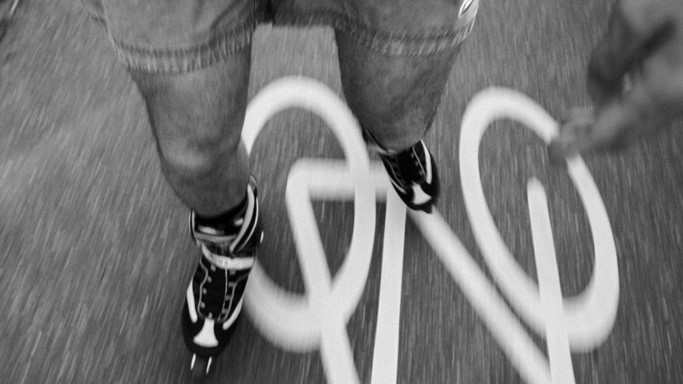
I used to live in Southern California in the mid-to-late 1990s, when Newport Beach seemed populated almost entirely by beautiful people who had figured out how to exercise without looking like they were exercising.
They were tan and fit and wore the right clothes. And they Rollerbladed.
Roller skates? Absolutely not. Roller skates belonged in a 1970s disco with a mirror ball overhead and the Bee Gees playing in the background.
These were Rollerblades. Sleek. Fast. Cool.
People glided down the boulevard beside the beach on them with long, effortless strides, looking as though ordinary walking had become obsolete.
My girlfriend at the time had grown up there. She knew the culture. She belonged there.
I was from Texas, but I was adaptable.
So I bought Rollerblades.
The plan was simple. I would meet my girlfriend at the beach, put them on, wobble around for a few minutes while I got the hang of it, and then the two of us would glide off together down the boulevard like we belonged there.
But there was one small problem. I had never Rollerbladed before.
This did not concern me.
I was reasonably athletic. Coordinated. I generally picked up physical things pretty quickly.
How hard could it be?
My girlfriend knew I had never done it before, so, knowing, when we met at the beach, she offered to give me a few pointers.
And I welcomed this…briefly.
There are moments in a man's life when he is willing to humble himself, provided the humiliation can be completed in under five minutes.
So she showed me how to stand and how to balance and how to push off.
I listened.
Then I tried.
And I could not do it.
I don't mean I wasn't particularly good at Rollerblading. I mean I appeared to have lost the ability to stand upright. My ankles buckled in directions ankles should not buckle. My feet hurt. My arms began flailing independently of the rest of my body. Every attempt to move forward seemed to create three new opportunities to fall backward.
Meanwhile, beautiful Californians sailed effortlessly past me while I looked like a newborn giraffe on wheels.
I fell.
I got up.
I fell again.
Before long my elbows were scraped, and so were my knees.
And my girlfriend was watching all of it.
I had come to the beach imagining myself gliding down the boulevard beside her looking cool, but instead, I was bleeding. But worse, I was ashamed.
There is a specific kind of shame that comes from being publicly bad at something you think you ought to be able to do, and I think men know this shame particularly well.
We like competence. We like knowing. We like being the guy who can figure things out. We like being useful. And there is nothing wrong with any of that. Competence is a good thing.
But competence can become something more than a skill.
It can become an identity.
Then I don't know how to do this stops being a simple statement of fact, and it begins to sound like an indictment.
There's something wrong with me.
So I kept trying a little bit longer. Long enough, at least, that I could later tell myself I had really given it a shot.
Then I sat down. Took off the Rollerblades. Walked back to my car. Opened the trunk. And threw them inside.
I never put them on again, and I’m pretty sure they stayed in that trunk until I sold the car.
For all I know, somebody bought a used car and discovered a “gently used” pair of Rollerblades in the back. They probably thought they'd gotten a bonus, but what they had actually found was evidence. Because I wasn't afraid of Rollerblading. I was afraid of being bad at Rollerblading.
And rather than remain in a situation where my incompetence was visible, I quit.
I don't think we men merely hide the things we aren't good at. Sometimes we withdraw from them altogether. We abdicate.
If I don't know how to do something, I can step away and let somebody else handle it.
If I'm uncomfortable with emotions, I can let my wife handle the emotional life of the family.
If I don't know how to talk with my children about something difficult, I can remain silent.
If I don't know how to repair a relationship, I can wait for the other person to make the first move.
If I don't understand what is happening inside me, I can decide that looking inside is unnecessary.
If I don't know how to pray anymore, I can stop praying.
And if any of those things go badly enough, I can always explain why somebody else is partly responsible.
That pattern is old. Very old.
The first man in the Bible does something remarkably similar, and I owe Larry Crabb and his phenomenal book, The Silence of Adam, for helping me see through this window.
I had heard the story of Adam and Eve told as though Eve wandered off by herself, encountered the serpent, ate the fruit, and then eventually came home and said, "Adam, you've got to try this." But Genesis gives us one devastating little detail. She gave some to her husband, who was with her.
Adam was there. And he was silent.
The serpent spoke. Eve spoke.
Adam said nothing. Did nothing. Abdication.
He stood beside the woman he had been given to love while everything came apart, and whatever else we might say about that old story, there is something painfully familiar in his passivity.
Then, when God came looking for him, Adam finally found his voice. First he hid. Then he blamed.
"The woman whom you gave to be with me..."
In a few words Adam manages to blame both Eve and God.
This woman.
Whom you gave me.
Suddenly everybody is responsible except Adam. Abdication.
And I know those two things—abdication and blame, because taking responsibility eventually brings us face-to-face with our limitations, right? Maybe I don't know what to do. Maybe I'm not good at this. Maybe I failed. Maybe I should have spoken and didn't. Maybe I should have acted and didn't. Maybe someone needed something from me that I didn't know how to give.
Those are painful things to admit.
It is much easier to put the Rollerblades in the trunk. Hide the evidence of our incompetence and walk away.
But there is a terrible price for that, because you cannot become good at something you refuse to be bad at first. You cannot learn what you already pretend to know. And you cannot take responsibility for something while continually explaining why it belongs to somebody else.
Some of the most important things a man will ever be asked to do are things he will not initially know how to do. Nobody handed me Rollerblades at birth. Nobody handed me instructions for being a husband either. Or a father. Or a friend.
I have had to learn how to listen. How to apologize. How to grieve. How to remain present when I cannot fix something. How to tell the truth about what is happening inside me. How to love another person when I don't understand them. How to take responsibility without immediately adding an explanation.
I'm still learning most of those things. And learning them requires something I wasn't willing to do on that beach.
Be a beginner.
Stand there wobbling. Let somebody teach me. Risk falling down while somebody I care about impressing is watching.
I’m convinced one of the most courageous sentences a man can learn to say is:
I don't know how to do this.
But that sentence isn't enough. Adam could have stood silently in the garden saying it.
There needs to be another sentence.
But I'm not leaving.
And perhaps another.
Will you teach me?
Or even better and more daring.
I need your help.
Because humility isn't abdication.
Humility doesn't say, I'm terrible at this, so you handle it.
Humility says, I'm not good at this yet and may never be, but it matters, so I'm staying.
I'm going to listen and try to learn. I'm going to take responsibility for my part, and while I'm going to fall down, I’m going to get back up. And when I fail, I'm going to try very hard not to blame the woman God gave me.
I wish I could tell you I learned all of that in Newport Beach.
I didn't.
I put the Rollerblades in the trunk.
But I've had a lot of years since then to discover how many other things I've been tempted to put in there with them. Questions I was afraid to ask. Conversations I wasn't sure how to have. Responsibilities I was tempted to leave to someone more capable. Places where I could have simply said, I don't know.
If you’re like me, maybe you have a few Rollerblades in the trunk.
Things we've decided we're simply "not good at" when the deeper truth is that we couldn't bear being bad at them long enough to learn. And perhaps the Way begins by opening the trunk. Take them back out. Put them on. Let somebody help you stand. Wobble. Fall. Get back up.
And this time, don't disappear because you're embarrassed.
Stay.
There are worse things than being a man who doesn't know what he's doing.
One of them is being a man who walks away because he won’t admit he needs help and is just a beginner.