Window 19
A Good Rest Stop
A Kentucky rest stop, two boys playing football, and a bird’s nest reveal what it means to care for the little corner of the world we’ve been given.
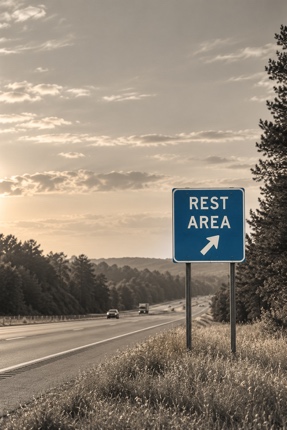
I know a good rest stop. This is not something I put on my résumé, but I probably could.
For several years I was a traveling salesman, which meant I spent an unreasonable percentage of my life driving interstate highways. And when you spend that much time on the road, you become something of a connoisseur of rest areas.
And I have seen things. Things I cannot unsee.
Bathrooms where you walked in, reconsidered just how badly you needed to go, and decided perhaps you could make it to the next state. So when I tell you I know a good rest stop, you should trust me.
And somewhere in Kentucky, years ago, I found a great one.
I noticed it almost as soon as I pulled in. The grass was beautifully cut. The landscaping was tended. There wasn't trash blowing around the parking lot. Everything looked cared for. There were even a couple of young boys tossing a football back and forth on one of the lawns. They looked like they'd probably been stuffed in the backseat of a car for several hours and had finally been released into the wild.
And the lawn was perfect for it.
I went inside. The bathrooms were spotless. I mean spotless. And perhaps this tells you something about how many miles I had driven by that point in my life, but I remember standing there thinking:
This is an impressive bathroom.
Which is not a thought I have often had.
When I came back outside, I noticed a man in a crisp uniform. I don't remember his exact title—superintendent, manager, caretaker—but it was obvious that he was responsible for the place.
And I decided to tell him what I thought. I walked over and said that I traveled a lot and had stopped at more rest areas than I cared to remember, and I wanted him to know that this was one of the nicest I'd ever seen. The grounds were beautiful. The facilities were immaculate.
And that he was clearly paying attention.
And he lit up. Not boastfully. He was simply pleased. He was proud of the place. And I don't think we talk enough about that kind of pride. We talk a lot about the bad kind—the pride that needs to be noticed, that needs to be better than somebody else, that says, Look at me.
This wasn't that.
This was the satisfaction of someone who had been given a little corner of the world to care for and had cared for it well. And someone had noticed, but more than that, someone had enjoyed it.
I know that mattered to him.
We talked for a few minutes, and while we were talking, I saw his attention shift over my shoulder.
He was looking at the boys playing football. He politely excused himself and walked toward them, and for a moment, I wondered if they were about to get in trouble. After all, this was a beautiful lawn. Maybe he didn't want two boys trampling all over it.
But that wasn't it at all. He seemed delighted that they were there. That was what the lawn was for. Two itchy, car-stuffed boys had finally escaped the backseat, and now they were running and throwing a football across this beautiful patch of Kentucky grass.
Soon enough, I realized that he didn't want them to stop. He just wanted them to move over a little. Because underneath them, almost hidden in the grass, was a bird's nest.
He pointed it out to them. He didn't scold them. He didn't chase them off his lawn. He simply showed them what he had seen and asked if they could move their game somewhere else.
And they did. Then they kept playing.
I've remembered that little scene for years, because everything I'd noticed about the place made sense because of him. The clean bathroom. The cut grass. The landscaping. The lack of trash. The boys playing football. The bird's nest.
They all belonged together.
He wasn't keeping the place clean because cleanliness was the point. He was caring for something. And he took pleasure in caring for it.
There is a kind of pride that says, Look what I have. But there is another kind that says, Look what I've been given to care for.
I think we need more of that kind, because I think that's closer to what God intended for us from the beginning. Before there were churches and sermons and mission statements and ministry strategies, there was a garden. And God put a human being in it to tend it.
To keep it. To notice.
Sometimes Christians can get so interested in doing something important for God that we miss the little piece of his world sitting directly in front of us. We want to change the world. But maybe we're supposed to tend our garden.
A classroom. A kitchen. A business. A hospital room. A little league team. A house. A rest area somewhere along an interstate in Kentucky.
Whatever patch of creation has been entrusted to us.
Do good work there. Take some pride in it. Make it beautiful if you can. And then enjoy it when somebody else enjoys what you've cared for.
That's what I remember most about that man. He was happy that I liked his rest stop. And he was happy those boys were playing on his grass. And when their joy threatened a tiny bird's nest they couldn't see, he didn't choose between the boys and the birds.
He walked over and helped the boys see it too. Then the boys kept playing. The birds kept their nest. And the superintendent went back to keeping his little corner of Kentucky.
I don't know that man's name. I don't know anything else about his life.
And I doubt he had any idea that a traveling salesman who stopped to use his bathroom would still be thinking about him decades later. But I am. Because for a few minutes beside an interstate, he showed me something about the Kingdom of God.
Maybe changing the world isn't always about doing something enormous. Maybe sometimes it is simply loving the little piece of it that has been entrusted to you.
Keeping the grass. Cleaning the bathroom. Letting the boys play. And noticing the birds.