Window 17
Prince Charming
Children grow up, and the little girls who once thought Daddy could fix almost anything eventually discover that there are things Daddy cannot fix. And sometimes Daddy is the thing that needs fixing.
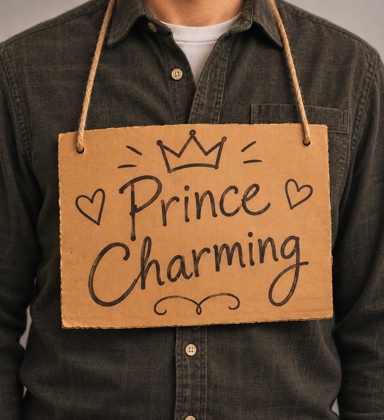
Since we’re still suffering our Halloween hangovers, I feel the need to give one more Halloween window. Hopefully as a cure to level out the candy gluttony some of us have gotten stuck in the last few days.
Years ago, when my daughters were little, Halloween was a fairly serious affair.
They were princesses. Of course they were princesses.
I lived in a house full of princesses in those days, which meant I knew far more about tiaras, gowns, sparkly shoes, and Disney royalty than any grown man ought to know.
My own Halloween costume required considerably less preparation. I wore my regular clothes.
Then I hung a sign around my neck that said:
PRINCE CHARMING.
That was it. No tights. Thank God. No sword. No white horse. Just me in ordinary clothes announcing to the world that I was Prince Charming. Which was revealing because down deep, I really did want my little girls to think I was Prince Charming.
And maybe even deeper down, I thought I was pretty good at it.
There is something wonderful about being a father to little girls. At least there was for me. For a few magical years, you possess powers you will never have again. You can fix things. You can reach things. You can scare away monsters. You can carry a sleeping child from the car to her bed. You know how to make pancakes. You can open jars. You can make bad things better simply by picking somebody up and holding her.
For a little while, Dad really does seem like a prince.
Percy Shelley once wrote beautifully about childhood:
“It is to believe in belief.”
He wrote of children living in a world where elves might still whisper in their ears, pumpkins could become coaches, mice could become horses, and nothing could become everything. Children live near the border of enchantment, and perhaps that is why little girls can look at a deeply flawed middle-aged man wearing khakis and a cardboard sign and see Prince Charming.
Shelley understood enchantment.
Unfortunately, understanding enchantment and being enchanting are not quite the same thing. Percy Shelley was one of the great Romantic poets. Brilliant. Passionate. Idealistic. The sort of man who could write sentences that made the ordinary world shimmer. But he was also rather impressed with Percy Shelley.
At seventeen, Mary Godwin fell in love with him. He was older, brilliant, rebellious, romantic, and already married. They ran away together, eventually married, and became one of literature's most famous couples.
You probably know Mary by her married name. Mary Shelley. And even if you've never read anything she wrote, you know her monster.
Frankenstein.
Although that's not actually the monster's name. Frankenstein is the doctor. Hollywood has done such a thorough job on the story that most of us picture a green fellow with bolts in his neck staggering around with his arms straight out.
Well, the book is far more frightening because the real horror isn't a monster.
It's a man.
Victor Frankenstein is brilliant, ambitious, and convinced that the ordinary limits placed upon human beings do not particularly apply to him. He wants to create life. He wants to conquer death. He wants to do what only God can do. And when he succeeds, he discovers that being powerful enough to create something is not the same thing as being wise enough to love it.
Some literary interpreters have seen traces of Percy in Mary's Victor Frankenstein—the brilliant Romantic man intoxicated with his own ideas, reaching beyond ordinary human limits while leaving other people to live with the consequences. Whether Mary consciously modeled Victor on her husband is debated, but she certainly knew something about brilliant men.
And she knew Percy.
There is always someone who knows Prince Charming without the cardboard sign. That person sees him when the carriage turns back into a pumpkin, and my daughters eventually did.
Children grow up, and the little girls who once thought Daddy could fix almost anything eventually discover that there are things Daddy cannot fix. And then they discover something even more unsettling:
Sometimes Daddy is the thing that needs fixing.
He loses his temper. He gets distracted. He says something he wishes he could retrieve. He misses things he should have noticed. He becomes preoccupied with his own problems. He disappoints them.
The prince turns out to be a man.
And perhaps one of the hardest transitions in fatherhood is realizing that this is not a tragedy. It may actually be necessary, because my daughters never really needed Prince Charming.
They needed a father.
A prince has to maintain the illusion. A father can apologize.
A prince rides in and saves the day. A father sometimes has to admit he doesn't know what to do.
A prince needs to be admired. A father needs to love.
And love is much harder than looking impressive on a white horse.
There is a strange temptation in all of us to become the person on the sign around our neck.
Good father. Good husband. Good pastor. Good Christian. Good person.
Prince Charming.
We want people to believe the sign, and sometimes, if enough people do, we begin believing it ourselves. But the people closest to us usually know better. They see behind the costume, and that may be one of God's great mercies.
Percy Shelley wrote about the beautiful ability of children to turn pumpkins into coaches and lowness into loftiness. But eventually the clock strikes midnight. The coach becomes a pumpkin again. The prince becomes an ordinary man standing in ordinary clothes.
And grace begins there. Not when I finally become the prince I always imagined myself to be, but when I can take the sign off. When I can stand before the people I love without needing them to believe I'm extraordinary. When I can say, I was wrong. I'm sorry. I don't know. I need help.
Growing older means losing some of the fairy tale, but perhaps we gain something better. My girls don't need to believe in Prince Charming anymore. And I don't need to be him. Thank God.
Regular clothes fit me better anyway.